

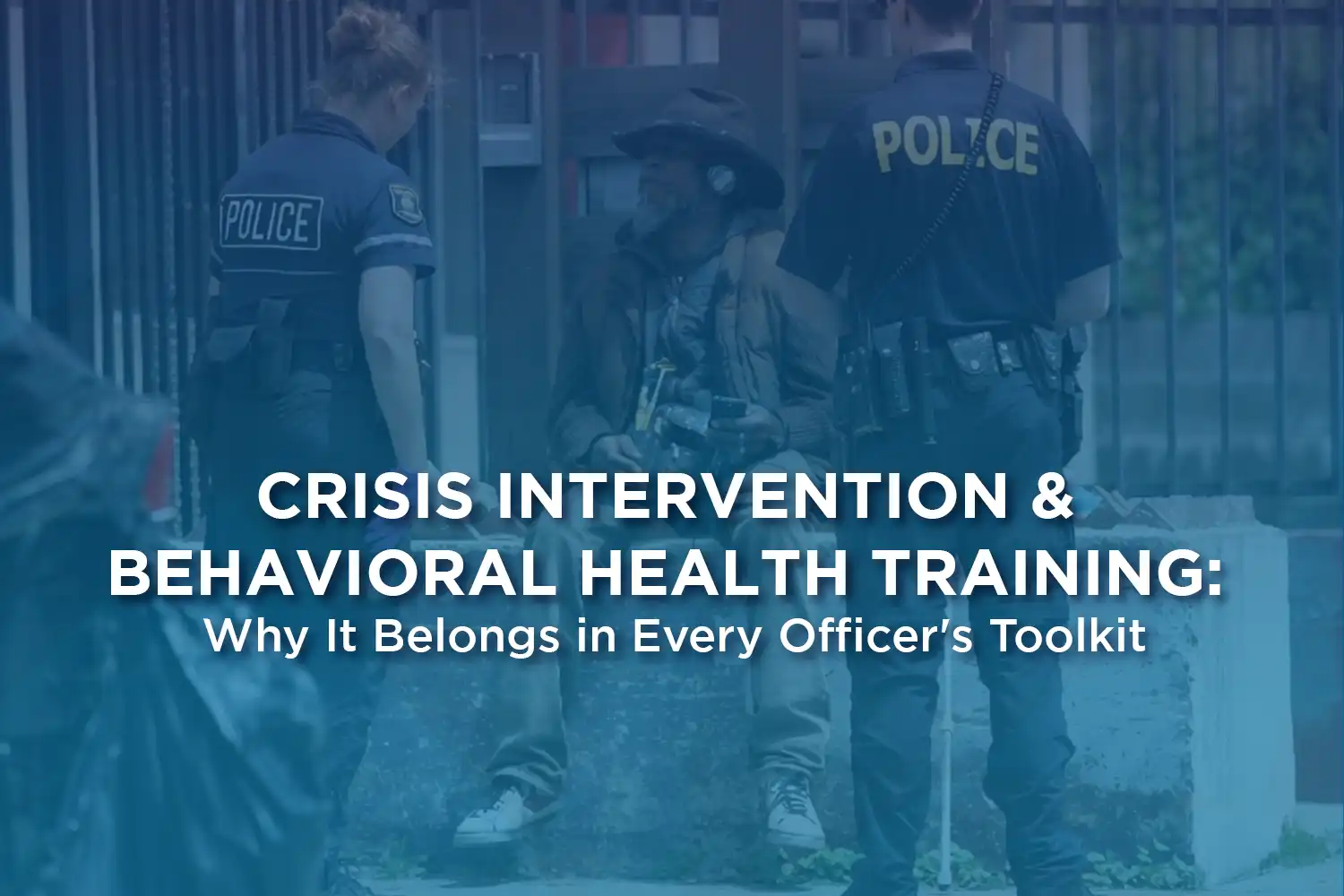
Aug 19, 2026 Crisis Intervention and Behavioral Health Training: Why It Belongs in Every Officer’s Toolkit
What is crisis intervention and behavioral health training?
Crisis intervention and behavioral health training is structured instruction that prepares officers to identify signs of mental illness, substance use disorders, and intellectual and developmental disabilities, and to respond with de-escalation techniques rather than escalation. It reframes a subject in crisis as a person who needs a specific set of communication tools, not simply a threat to be controlled.
Effective programs combine three things: clinical knowledge of the conditions officers encounter, practical de-escalation skill-building through real-world scenarios, and the lived experience of people who manage mental illness every day. The goal is not to turn officers into clinicians. It is to give them enough understanding to make the first few minutes of a crisis go effectively.
Why does crisis intervention training matter for law enforcement?
It matters because the encounters it prepares officers for are disproportionately deadly. People with untreated serious mental illness are 16 times more likely to be killed during a police encounter than other civilians approached or stopped by law enforcement, according to the Treatment Advocacy Center’s report Overlooked in the Undercounted.[1] The same research found that people with untreated mental illness are involved in at least one in four fatal police shootings.[1]
A separate, decade-long analysis by The Washington Post, which has tracked every fatal on-duty police shooting since 2015, found that more than one in five people fatally shot by police were experiencing a mental health crisis — over 1,400 people in the database’s first ten years.[2] These are not fringe cases. They represent a consistent, recurring category of encounter that officers will face throughout their careers.
How often do officers actually encounter people in crisis?
Far more often than most training budgets reflect. With more than one in five American adults living with a mental illness, behavioral health is a factor in a large share of routine calls — welfare checks, disturbances, homelessness contacts, and family disputes among them. The person on the other end of the call is frequently someone whose condition, not criminal intent, is driving the behavior.
These calls also carry real risk to officers. The FBI’s Law Enforcement Officers Killed and Assaulted (LEOKA) program, which compiles national data on officer safety, consistently ranks disturbance calls — a category that includes domestic disputes and behavioral-health-related disturbances — among the leading circumstances in which officers are assaulted in the line of duty.[4] In other words, the same encounters that most endanger people in crisis are also among the most dangerous for the officers responding to them. Better preparation protects both.
What does behavioral health training teach officers?
Quality behavioral health training moves officers from recognition to an effective and safe response. It builds a working understanding of the conditions most likely to surface on a call, then pairs that knowledge with the communication skills to manage the moment safely.
A comprehensive curriculum typically covers:
- Recognizing mental illness — including mood disorders such as bipolar disorder, psychotic disorders such as schizophrenia, and the behaviors that distinguish a crisis from criminal conduct.
- Substance use disorders — how intoxication and withdrawal present in the field and how they intersect with mental health.
- Developmental and intellectual disabilities — signs, symptoms, and communication approaches that prevent misreads.
- De-escalation techniques — practical, repeatable tools to lower the temperature of an encounter and buy time.
- Reducing stigma — understanding how deinstitutionalization and stigma shaped today’s landscape, so officers respond to the person rather than the label.
- Connecting to resources — knowing the off-ramps, from crisis lines to community services, that resolve a call without an arrest or a use of force.
The most durable programs add something a slide deck cannot: a guest speaker who lives with mental illness and shares, in their own words, what a police contact feels like from the other side. That perspective tends to reshape how officers approach the next call more than any statistic.
Is crisis intervention training required by law?
In California, yes — for a growing share of officers. Senate Bill 29 requires all Field Training Officers (FTOs) to complete at least eight hours of crisis intervention and behavioral health training. Because FTOs set the standard that new officers absorb in their first months on the street, the law effectively pushes behavioral health competency into the foundation of a department’s culture.
Beyond the mandate, training that is California POST- and STC-certified ensures the hours count toward officers’ and corrections professionals’ continuing requirements — so agencies meet their obligations and strengthen their teams in the same eight hours.
What outcomes does the training produce?
The payoff shows up in how calls end. Officers who complete behavioral health training report greater confidence in crisis situations and a clearer understanding of when a person needs treatment rather than a cell. De-escalation skills translate into fewer uses of force, safer outcomes for the person in crisis, and lower risk to the officers involved — the measurable difference between an encounter that escalates and one that resolves safely.
There is a broader shift underway that reinforces this work. The nationwide 988 Suicide & Crisis Lifeline, launched in 2022, was designed in part to route mental health crises to trained responders and reduce reliance on police. But officers will always be part of the response system, especially when safety is in question. Training ensures that when they are the ones who arrive, they arrive prepared.
Where can law enforcement get crisis intervention and behavioral health training?
Embassy Consulting Services delivers an 8-hour, interactive Crisis Intervention and Behavioral Health Training built specifically for law enforcement and public safety professionals. The course is California STC- and POST-certified and fulfills the Senate Bill 29 requirement for Field Training Officers.
The training is facilitated by a law enforcement professional with mental illness expertise and features a guest speaker who shares the reality of living with a mental illness. Rather than lecture, it works through real scenarios so officers leave with tools they can use on the next shift. The curriculum spans mental illness, stigma, substance use disorders, intellectual and developmental disabilities, and field-ready de-escalation — the full range of what officers encounter.
Explore the Crisis Intervention and Behavioral Health Training course →
See upcoming class dates and register →
Frequently asked questions
What is crisis intervention and behavioral health training for police?
It is structured training that prepares officers to recognize mental illness, substance use disorders, and developmental disabilities, and to de-escalate a person in crisis using communication skills rather than force — then connect that person to appropriate care.
How long is Embassy’s crisis intervention and behavioral health course?
The course is eight hours, delivered in an interactive format that combines instruction, real-world scenarios, and a guest speaker with lived experience of mental illness. It is California STC- and POST-certified.
Does the training satisfy California Senate Bill 29?
Yes. Embassy’s Crisis Intervention and Behavioral Health Training fulfills the Senate Bill 29 requirement that all Field Training Officers complete at least eight hours of crisis intervention and behavioral health training.
Why is behavioral health training important for officer and public safety?
People with untreated serious mental illness are 16 times more likely to be killed in a police encounter, and disturbance calls are among the most dangerous circumstances for officers. Training reduces use-of-force incidents and improves outcomes for everyone involved.
Who should take crisis intervention and behavioral health training?
Law enforcement officers, corrections professionals, field training officers, and civilian public safety personnel who respond to or support calls involving mental or behavioral health crises.
Sources
- Treatment Advocacy Center, Overlooked in the Undercounted: The Role of Mental Illness in Fatal Law Enforcement Encounters. ↩
- The Washington Post, Fatal Force police shootings database (2015–2024). ↩
- National Institute of Mental Health, Mental Illness statistics. ↩
- Federal Bureau of Investigation, Law Enforcement Officers Killed and Assaulted (LEOKA). ↩
